


Dear Stargazing Readers and Cosmic Wanderers,
A major eclipse is coming, and I would like you to be appropriately alarmed and appropriately delighted, in roughly equal measure. This Wednesday, the sky is offering a rare moment: a total solar eclipse, and the first one over European soil since 1999. If you were alive in 1999, you were probably wearing questionable eyewear and listening to a Discman. That is how long it's been.
This is, in other words, not a drill.
I'll be watching from the Dutch North Sea coast myself, at around 8pm for a sunset partial glance. If you want the full technical rundown of the celestial mechanics, TimeandDate has a genuine piece covering the science behind it.
About the August 2026 Total Solar Eclipse
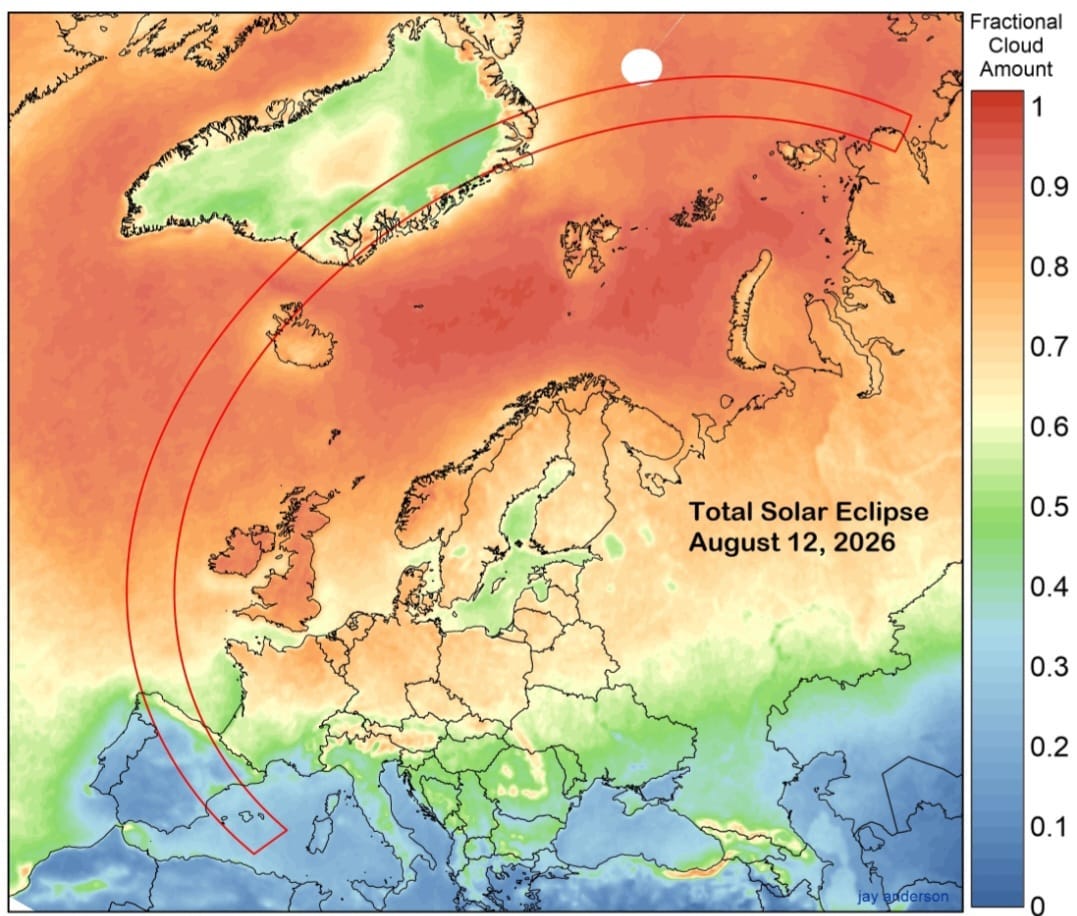
Totality itself will sweep across Greenland, Iceland, the Atlantic, Spain, Portugal, a sliver of France and move over Russia. The rest of the northern hemisphere gets the partial version: most of Europe, northern parts of the US, most of Canada, and northwestern Africa.
Astrologically, a solar eclipse is a New Moon that's had three espressos. It's the same symbolism as a New Moon: endings, beginnings, a blank page turned up so loud that the whole planet feels it, whether you personally glance up or not. I like to think of it as an electromagnetic reset, the cosmic equivalent of unplugging a malfunctioning router and plugging it back in. Sometimes chaotic in the moment, though usually working better afterward.
Now. Eclipses have a reputation, and I won't pretend they haven't earned some of it. I've lived through a few rough ones myself as last year's spring eclipse season took my mother, and the former Pope. Eclipse season doesn't ask permission. And yet, it could just as easily be the start of the best year of your life. Endings are real, but they tend to be in service of something. Eclipses have an uncanny habit of redirecting us onto the path that's actually good for us, even when it looks, in the moment, like we are actually loosing gravity.
A solar eclipse works by dragging your unfinished business into direct sunlight. Whatever's been quietly debilitating you gets illuminated, whether you asked for the spotlight or not, and the effect is strongest for anyone whose birth chart lines up with the eclipse degree. One practical note while we're here: don't look directly at the eclipse, obviously, and also don't make any major life decisions in the days around it. Nothing of material consequence three days before, the day of, or three days after. Your judgment is compromised right now. Not permanently. Just currently.
Here's the thing I've noticed, season after season: eclipses love to push you off the fence. Should I leave this relationship or stay? Do I quit the job that's slowly hollowing me out and finally start the thing I actually want to build? Clients come to me stuck on the exact same question for months, sometimes years, and then I look at their chart, see an eclipse bearing down on their Sun, and think: well, there it is. The decision is about to make itself.
It rarely feels gentle in the moment. But on the other side of it, you're free to move into a new timeline. You meet the person, you land the job with the work-life balance you'd stopped believing was possible. Eclipses are, more often than not, a blessing wearing a very convincing disguise.
Who should actually be paying attention?
In my experience, eclipses within 5° of your natal Sun hit hardest, with oppositions and squares to your Sun close behind.
This particular eclipse falls at 20° Leo, which means you'll want to sit up if your birthday falls between August 8th and 18th, or to the eclipse's opposite point in Aquarius, February 4th to 14th. It'll register to a lesser degree if you were born May 6th–16th or November 8th–18th. And if you know your chart well enough to check placements and angles, watch for anything sitting between 15° and 25° of Leo or Aquarius, with Taurus or Scorpio placements catching a lighter version of the same wave.


